
What is a pope?
“The Pope, Bishop of Rome and Peter’s successor, ‘is the perpetual and visible source and foundation of the unity both of the bishops and of the whole company of the faithful.’1
A bland definition, however useful.
I prefer to define a thing by what it does.
This is far from an exhaustive list–any ecclesiologist can tell you that–but for my purposes here it will suffice.
A pope is to lead the People of God in love.2
A pope’s work is “to form consciences, not to replace them.”3
A pope is to work alongside all the Catholic clergy and laity of the world as the decentralized leader of a family.4
A pope is to love everyone but particularly the poor and to exhort the world to greater solidarity.5
In other words, a pope is to be like Christ: to call us to deeper conscientiousness, to work through problems with us, to help us act in solidarity with our neighbor; all out of selfless love. Pope Francis did all these things, imperfectly but devotedly, and I will not waste space with proof-texting to demonstrate it.
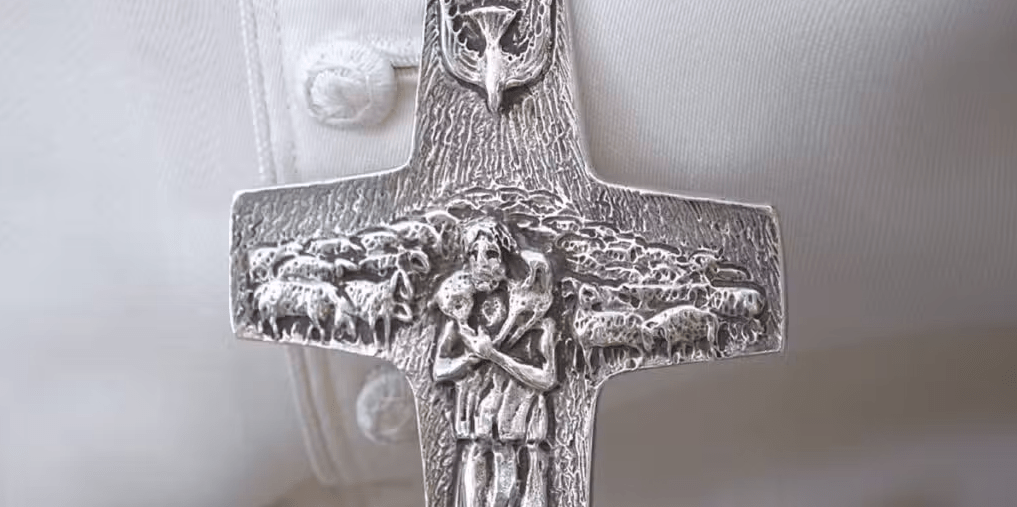
That Christians are Christ’s flock of sheep is a common enough image that it doesn’t require explanation here. Reflecting Christ, the pope is a sort of “head shepherd” of the Church. But his job is, in a paradoxical way, to constantly work to replace himself without replacing himself. He helps us form our consciences so that our own consciences can shepherd us through life’s difficulties–after all, a pope can never come up with solutions to all our world’s problems.6 It is the supreme paradox of the papacy that this chief shepherd’s job is to turn all his sheep into shepherds themselves.
Putting the matter this way would certainly prove controversial among many Catholics, but it is not a mere play on words. I find this idea especially embedded in two major theological themes that come out of the Second Vatican Council: that Christ is the divine priest, prophet, and king, and that every Christian, by our baptism, shares in that three-fold office.7 And this point of view is incipient in some of the great theologians and saints of the Catholic Tradition.
St. Augustine, commentating on Psalm 26: “David was anointed king. In those days only a king and a priest were anointed. These two persons prefigured the one and only priest and king who was to come, Christ (the name ‘Christ’ means ‘anointed’). Not only has our head been anointed but we, his body, have also been anointed . . . therefore anointing comes to all Christians, even though in Old Testament times it belonged only to two persons. Clearly we are the Body of Christ because we are all ‘anointed’ and in him are ‘christs,’ that is, ‘anointed ones,’ as well as Christ himself, ‘The Anointed One.’ In a certain way, then, it thus happens that with head and body the whole Christ is formed.”8
Pope St. John Paul II makes clear, “The Second Vatican Council has reminded us of the mystery of this power and of the fact that the mission of Christ–Priest, Prophet-Teacher, King–continues in the Church. Everyone, the whole People of God, shares in this threefold mission.”9
St. Oscar Romero, in these striking words: “As I told you, the preacher not only teaches, but learns. You teach me. Your attention is also for me the Holy Spirit’s inspiration. Your rejection would be for me God’s rejection also. That is why I told you that the people have a sense of infallibility called the sense of faith. The Holy Spirit gives it to the humblest woman of the people, to everyone, so that when you listen to a bishop or a priest you can discern.”10 He says elsewhere, “The Church must propose an education that makes people agents of their own development, protagonists of history, not a passive, compliant mass, but human beings able to display their intelligence, their creativity, their desire for the common service of the nation.”11
We are already Christ’s sheep. But if the Church is to obey the Gospel, its work is to make all of us Christians into shepherds.
To end with, again, Romero: “Christ arisen has put in history’s womb the beginning of a new world. To come to Mass on Sunday is to immerse oneself in that beginning, which again becomes present and is celebrated on the altar at Mass.”12
To immerse ourselves in that new beginning is our Christian life. To enable our immersion is the task of the priest, and we are all priests in the parishes of our lives. To immerse the world–the parish of St. Peter–that is the task of the Bishop of Rome. To be the priest of the whole world. To teach and guide until we can speak, like the unionists of old,13 with a priestly authority: “We are all shepherds.” That is what a pope is.
So let us pray for Leo XIV as he begins this work of being a pope.
- Catechism of the Catholic Church, 882, citing Lumen Gentium of the Second Vatican Council ↩︎
- Episcopalis Communio, 10 ↩︎
- Amoris Laetitia, 37 ↩︎
- Evangelii Gaudium, 16 ↩︎
- Evangelii Gaudium, 58 ↩︎
- Evangelii Gaudium, 184 ↩︎
- Lumen Gentium, 10 ↩︎
- En. Ps. 26(2).2 cited in Christifideles Laici, 14 ↩︎
- Christifideles Laici, 13 ↩︎
- Homily on July 16, 1978 ↩︎
- Homily on January 22, 1978 ↩︎
- Homily on July 15, 1979 ↩︎
- https://www.epls.org/251/The-Everett-Massacre ↩︎
Discover more from The Bending Cross
Subscribe to get the latest posts sent to your email.
